
Many tech enthusiasts wonder if Python counts as a true scripting language or something more complex. Python works perfectly as a scripting language, allowing users to write small programs that automate boring tasks and save time.
This guide breaks down Python’s role as both a scripting tool and a powerful programming language, clearing up the confusion once and for all. The answer might surprise you.
Key Takeaways
- Python works as both a scripting language and general-purpose programming language, running through an interpreter without compilation steps.
- Over 614,339 packages exist on PyPI, making Python perfect for automation tasks like file processing and data scraping.
- Python’s dynamic typing system and readable syntax help beginners write scripts quickly while satisfying experienced programmers.
- Major companies use Python implementations like CPython and PyPy to run scalable applications across Windows, macOS, and Unix systems.
- Python’s standard library includes modules for internet protocols, databases, and regular expressions, making it ideal for system administration work.
What makes Python a scripting language?

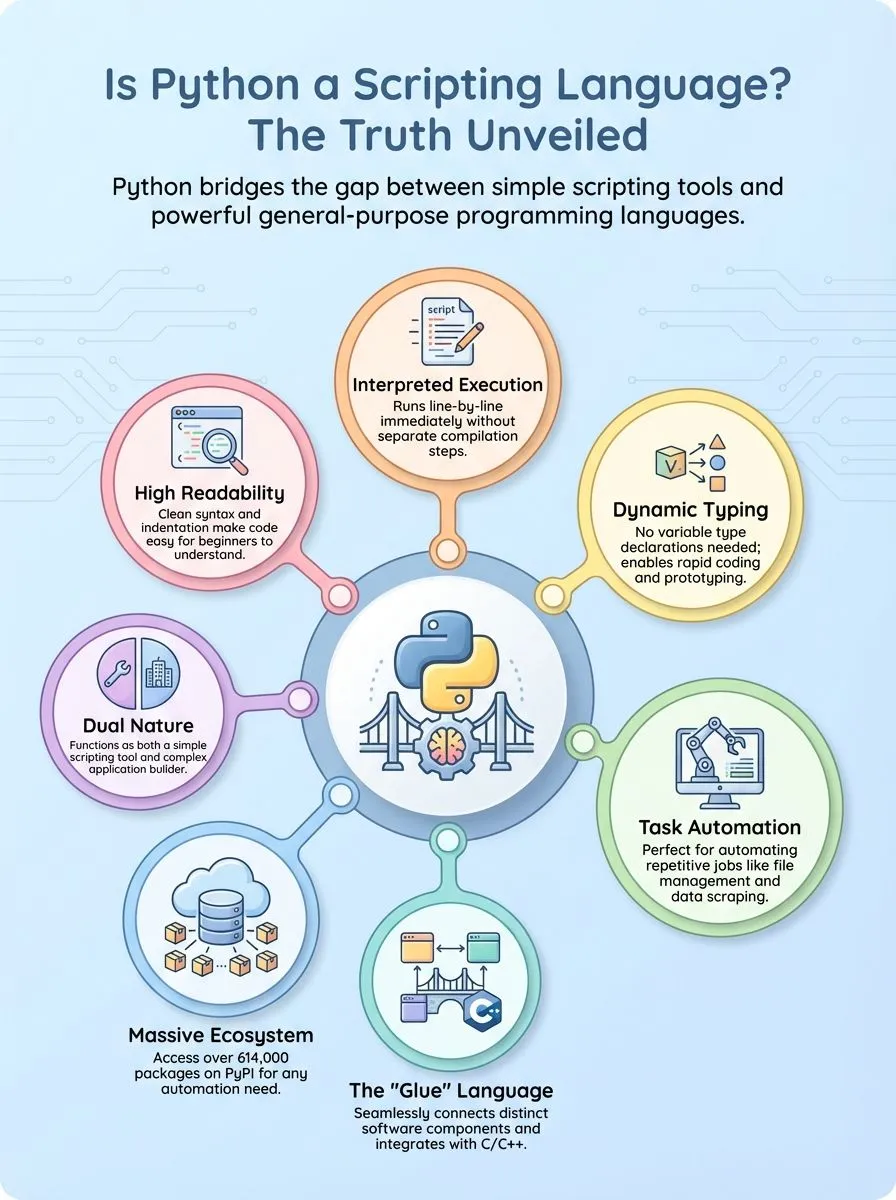
Python fits the scripting language role perfectly because it runs through an interpreter rather than a compiler. This means Python code executes line by line without needing a compilation step first.
The python interpreter reads your source code directly and turns it into action. Scripts written in Python automate tasks that people would normally do by hand. These short programs handle jobs like renaming files, processing text, or scraping data from websites.
Python’s dynamic typing system makes scripting simple and fast. Variables don’t need type declarations, so programmers can write code quickly. The language works great as a glue language that connects different software pieces together.
Python’s large standard library gives scripters ready-made tools for common tasks. Over 614,339 packages exist on PyPI, making almost any automation job possible. Scripts in Python often stay small and focused on specific problems, which matches how scripting languages typically work.
Python’s Dual Role: Scripting and General-Purpose Programming
Python serves two distinct roles in the programming world, acting as both a powerful scripting language and a comprehensive general-purpose programming language. This flexibility makes Python unique among programming languages, allowing developers to use it for quick automation tasks and complex software applications alike.
How does Python function as a scripting language?
Python’s interpreter makes script execution simple and fast. Users can run Python scripts directly from the command line without compilation. This feature supports rapid script development and testing.
The language’s dynamic typing system allows programmers to write scripts quickly. Reference counting and cycle-detecting garbage collector handle memory management automatically. Scripts can be run interactively through Python’s built-in REPL (read-eval-print loop).
This interactive environment lets developers test code snippets instantly.
Most Python scripts focus on automating repetitive tasks like data processing and file management. The standard library includes modules for internet protocols, databases, and regular expressions.
These tools make Python perfect for system administration work. Scripts typically stay short and personal, designed to boost efficiency in specific environments. Python excels as a “glue language” that connects components written in C or C++.
This capability helps create complex workflows through simple scripts. The language’s readable syntax makes it easy for beginners to start scripting right away.
In what ways is Python used for general-purpose programming?Python’s ease of use and readability make it a preferred choice for scripting among beginners and experienced programmers alike.
Python serves as a complete programming solution that goes far beyond simple scripts. Developers create full web applications using frameworks like Django, build desktop software with libraries such as PyQt, and construct complex machine learning systems with tools like PyTorch and NumPy.
The language’s object-oriented programming capabilities allow programmers to design large programs with custom classes and sophisticated data structures. Python’s standard library supports GUI development, database connections, and network programming, making it perfect for enterprise-level applications.
Major companies rely on Python implementations like CPython and PyPy to run scalable applications across Windows, macOS, and Unix systems. The language excels in scientific computing, where researchers use SciPy for complex calculations and data analysis.
Python’s built-in data types including dict, list, tuple, and set provide the foundation for handling massive datasets in real-world applications. Web Design Booth has witnessed firsthand how Python’s versatility enables creative professionals to automate workflows, analyze user data, and build custom tools that streamline their digital marketing efforts.
What features make Python ideal for scripting?
Python’s syntax emphasizes code readability, making it perfect for quick scripts and automation tasks. The language uses indentation to define code blocks, which creates clean and easy-to-read programs.
This design follows principles from “The Zen of Python” (PEP 20), which guides developers toward simple and clear code. Python is dynamically typed, which means programmers don’t need to declare variable types before using them.
This feature enables rapid development and reduces boilerplate code that other programming languages require. Scripts written in Python can be executed directly without compilation, supporting rapid prototyping and automation workflows.
The fast learning curve makes Python accessible to beginners, while experienced developers appreciate its flexibility for complex scripting tasks.
Python’s comprehensive standard library provides modules for regular expressions, internet protocols including MIME and HTTP, unit testing, and arbitrary-precision arithmetic. The Python Package Index (PyPI) listed over 614,339 third-party packages as of March 13, 2025, which greatly expands scripting capabilities for any project.
Functional programming tools like itertools and functools in the standard library are frequently used in scripting scenarios. Python’s dynamic name resolution, also called late binding, resolves names at runtime and promotes flexibility in scripting environments.
This runtime feature allows scripts to adapt and change behavior based on conditions during execution. The interpreted nature of Python means scripts run immediately without needing separate compilation steps, making it ideal for automation, data processing, and system administration tasks.
Conclusion
Python proves itself as a true scripting language while offering much more to creative professionals and tech enthusiasts. This versatile programming tool handles quick automation tasks and builds complex applications with equal skill.
Content creators can write simple scripts to organize files, while developers craft entire web platforms using the same Python foundation.
Python’s clean syntax makes learning enjoyable for beginners, yet its powerful features satisfy experienced programmers building advanced projects. Whether someone needs a quick script or a complete software solution, Python delivers the tools to make ideas come alive.
For more insights into Python’s evolving capabilities, read our article on the future of Python.
FAQs
1. Is Python a scripting language or a programming language?
Python is both a scripting language and a full programming language. Python can be used as a scripting language for automation tasks, and it also works as a complete programming language for building complex applications. The python language offers flexibility that lets developers use it in many different ways.
2. What makes Python different from other scripting languages like Perl?
Python uses clean syntax and semantics that make code easy to read and write. Unlike Perl and other interpreted languages, Python follows the off-side rule for indentation style, which makes programs more organized. Python 3 also provides better error handling and a more consistent type system than many scripting languages.
3. How does Python compare to compiled languages like Java and C?
Python is an interpreted programming language that runs through a python runtime, while Java and C need to be compiled into machine code first. Python programs run slower than native code from C and C, but they are much easier to write and test. The python compiler converts code to bytecode, which the interpreter then executes.
4. Can Python be used for web development and other applications?
Python can be used for web development, data science, and many other tasks beyond simple scripting. Python web frameworks make it easy to build websites, while python programs can also handle complex mathematical calculations. The language is used in everything from simple automation scripts to large enterprise applications.
5. What are the main advantages of using Python as a scripting language?
Python offers simple syntax that beginners can learn quickly, making it perfect for scripting tasks. The python tutorial shows how easy it is to write scripts that automate boring tasks. Python also has a huge library collection that provides ready-made solutions for common programming problems.
6. Do I need special tools to run Python scripts?
You only need the Python interpreter installed on your computer to run python scripts. You can download Python from python.org and start writing scripts right away. Unlike compiled languages, python programs do not need to be compiled before running, which makes testing and debugging much faster.