

Python developers often struggle with keeping track of item order in their dictionaries, especially when building applications that depend on sequence. The ordered dictionary python feature preserves the exact order items get added, making it perfect for data processing tasks.
This guide breaks down OrderedDict basics, shows practical examples, and explains when regular dicts fall short. Master these tools to write cleaner, more predictable code.
Key Takeaways
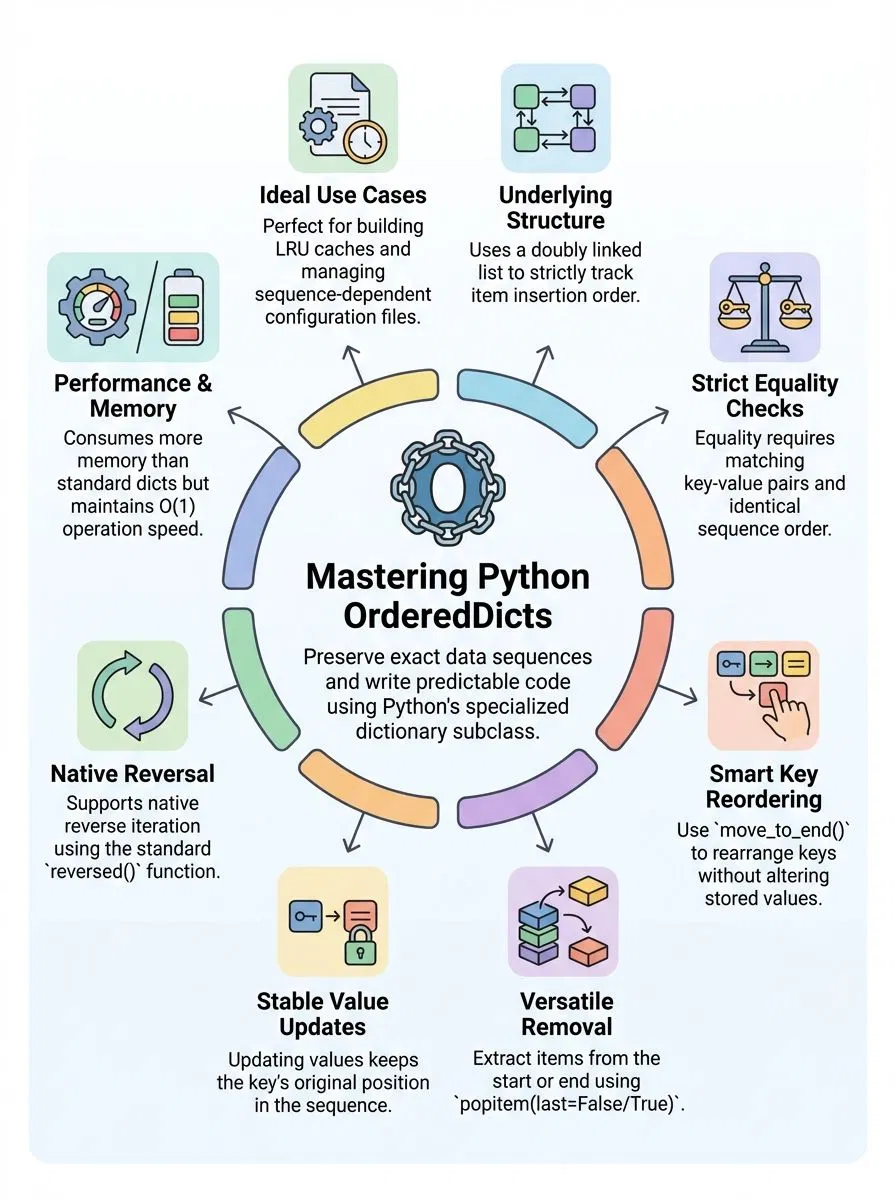
- OrderedDict preserves insertion order since Python 3.1 using doubly linked lists, unlike regular dictionaries until Python 3.7.
- OrderedDict equality checks compare both key-value pairs and their sequence, making order crucial for comparisons between instances.
- The move_to_end() method allows O(1) key repositioning to front or back, perfect for LRU cache implementations.
- OrderedDict uses more memory and runs slower than regular dictionaries due to its underlying linked list structure.
- Stack Overflow’s dictionary sorting question has 5.8 million views, showing OrderedDict’s importance for order-sensitive Python applications.
What is an OrderedDict?
 OrderedDict stands as a special dictionary subclass that remembers the order of items as they get added. This data structure arrived in Python 3.1 as part of the collections module, solving a major problem developers faced with regular dictionaries.
Alex Herrick discovered this feature while building custom WordPress themes that required maintaining specific key sequences for CSS properties. The underlying dictionary implementation uses a doubly linked list to track insertion order, making it different from standard dict objects that didn’t preserve order until Python 3.7.
The collections import brings OrderedDict into any Python project, creating ordered data that maintains the original order of keys throughout the program’s lifecycle. This dictionary subclass is faster than creating new data structures from scratch when order matters.
Joshua Correos often uses OrderedDict in digital marketing scripts where maintaining the sequence of campaign parameters affects the final output. The implementation detail that sets OrderedDict apart involves its ability to handle reordering operations, something regular dictionaries cannot accomplish even in newer Python versions.
Key Features of OrderedDict
OrderedDict brings special powers to Python dictionaries that regular dictionaries don’t have. These features make OrderedDict perfect for tasks where the order of your data matters most.
How does OrderedDict preserve insertion order?
OrderedDict maintains insertion order by using a doubly linked list behind the scenes. This smart design choice makes it different from regular dictionaries in older Python versions.
The linked list structure connects each key-value pair to the next one in line. This creates a clear chain that shows exactly when each item was added to the dictionary.
Each time someone adds a new key-value pair, OrderedDict appends it to the end of the linked list. This process preserves the exact order of insertion without any guesswork. The doubly linked list keeps track of both forward and backward connections between items.
This dual connection system makes it easy to move through the dictionary in either direction. The OrderedDict implementation ensures that order stays consistent even after deletions and reinsertion of keys happen.
This reliability makes OrderedDict perfect for situations where key order matters most.
Why do value updates not change the order in OrderedDict?
OrderedDict maintains the original insertion order when users update existing key values. This design choice ensures that order reflects the history of key insertions, not modifications.
The key remains in its original position even after value changes. This behavior supports reliable iteration order in scenarios like serialization and configuration management.
Value updates operate as O(1) operations, just like in regular dict structures. Only deleting and reinserting a key will move it to the end of the order. This feature proves important for applications like LRU caches, where only explicit reordering should affect order.
The immutability of order upon update distinguishes OrderedDict from some other ordered mapping implementations, making it perfect for tracking insertion history while preserving performance.
How does OrderedDict handle equality checks with order?
OrderedDict objects check equality in a special way that makes order crucial. Two OrderedDict instances are equal only when their key-value pairs appear in the exact same sequence.
This differs completely from regular Python dictionaries, where order plays no role in equality comparisons. The feature existed since OrderedDict’s introduction in Python 3.1, making it a reliable tool for order-dependent applications.
OrderedDict equality checks compare both key-value pairs and their sequence in the linked list, maintaining this behavior even after updates or reordering operations.
Alex Herrick discovered this behavior while building configuration management systems at Web Design Booth. His team needed to verify that ordered configuration files matched exactly, including their sequence.
OrderedDict’s order-sensitive equality proved perfect for this use case. The equality checks work regardless of key or value types, making them versatile for different data structures.
This property remains consistent even after using methods like move_to_end or other reordering operations. Developers use this feature in LRU cache implementations and other scenarios where sequence matters for data integrity.
How can you reverse an OrderedDict?
While equality checks compare order between OrderedDicts, developers often need to work with data in reverse sequence. Python 3.5 introduced reverse iteration support for OrderedDict items, making this task simple and efficient.
The `reversed()` function works directly on OrderedDict objects to iterate in reverse order. This built-in approach leverages the doubly linked list structure that maintains insertion order.
Developers can also use `popitem(last=False)` to remove items from the beginning, creating reverse popping functionality for applications like undo stacks or recent-history views. The preservation of insertion order allows easy reversal without affecting the underlying dictionary structure, unlike unordered mappings that lack this capability.
How do Python dictionaries work syntactically?
Python dictionaries use simple syntax that makes data storage easy. Developers create dictionaries with curly braces `{}` or the `dict()` constructor. Keys and values pair together inside the braces, separated by colons.
Each key-value pair gets separated by commas. Python’s built-in `dict` is a mapping type that associates keys with values using this straightforward approach. The syntax looks clean: `my_dict = {‘name’: ‘Alex’, ‘age’: 30}` creates a basic dictionary structure.
Dictionary methods work through dot notation, making operations simple to perform. Users access values by placing keys inside square brackets after the dictionary name. The language treats dictionary keys as unique identifiers that point to specific values.
Python functions can modify dictionaries during runtime, adding or removing items as needed. Variables store dictionary references, not copies, which affects how assignments work. This design makes dictionaries powerful tools for organizing data in Python programs.
Operations on OrderedDict
OrderedDict offers powerful methods that regular dictionaries lack, making data manipulation more precise and predictable. These specialized operations give developers complete control over key positioning, item removal, and dictionary structure while maintaining the insertion order that makes OrderedDict so valuable.
How do you add and remove items in an OrderedDict?
OrderedDict operations work just like regular Python dictionaries with one key difference. These operations maintain the insertion order while you modify the dictionary contents.
- Add new items using bracket notation – Simply assign a value to a new key like
ordered_dict['new_key'] = 'value'and Python appends it to the end of the dictionary order. - Remove items with the del keyword – Use
del ordered_dict['key_name']to delete any key-value pair from your OrderedDict, which removes it from both the order and underlying mapping. - Pop items with the pop() method – Call
ordered_dict.pop('key_name')to remove a specific key and return its value, or usepop('key', default_value)to avoid errors. - Remove from ends using popitem() – The
popitem(last=True)method removes items from the end whilepopitem(last=False)removes from the front of the order. - Clear all items at once – Use the
clear()method to remove every key-value pair from your OrderedDict in one operation. - Update existing values without changing order – Assign new values to existing keys like
ordered_dict['existing_key'] = 'new_value'and the position stays the same. - Delete and reinsert to change position – Remove a key first, then add it back to move that entry to the end of the dictionary order.
- Enjoy O(1) performance – All insertion and deletion operations run in constant time at both ends thanks to the doubly linked list structure.
How can you move keys to the front or end in an OrderedDict?
OrderedDict provides a powerful method called move_to_end()() that lets developers rearrange keys without affecting their values. This feature makes OrderedDict perfect for building custom data structures like LRU caches.
- Use move_to_end(key, last=True) to move any key to the end position. This operation runs in O(1) time thanks to the underlying linked list structure that OrderedDict uses internally.
- Set the last parameter to False to move keys to the front instead. The syntax becomes move_to_end(key, last=False) and maintains the same fast O(1) performance.
- Move keys multiple times without breaking the dictionary’s integrity. OrderedDict handles repeated key movements smoothly, making it ideal for algorithms that need frequent reordering.
- Build LRU caching systems using the move_to_end method effectively. This method was specifically designed to support cache implementations where recently used items move to specific positions.
- Rearrange keys while keeping all associated values unchanged and intact. The move operation only affects key positions, never the actual data stored in the dictionary.
- Access this functionality since Python 3.1 when OrderedDict first appeared. Regular dictionaries don’t offer this move_to_end capability, making OrderedDict unique for position-sensitive applications.
- Create custom orderings for specialized data structures using key movement. Developers can maintain specific arrangements that regular dict objects cannot provide.
- Implement queue-like behaviors by moving keys to front or back positions. This flexibility helps create double-ended queue functionality within dictionary structures.
How do you pop the first or last item from an OrderedDict?
Moving keys around sets up the foundation, but developers often need to remove items completely. The popitem() method provides precise control over which entries to extract from ordered dictionaries.
- Use
popitem(last=True)to remove and return the last inserted key-value pair from your OrderedDict, making it behave like a stack data structure. - Call
popitem(last=False)to remove and return the first inserted pair, creating queue-like behavior for your ordered dictionary operations. - The operation runs in O(1) time complexity due to the underlying doubly linked list implementation, making removal extremely efficient for large datasets.
- Stack behaviors emerge naturally when you consistently use
popitem()with the defaultlast=Trueparameter for LIFO processing patterns. - Queue implementations become possible by setting
last=False, enabling FIFO processing for ordered dictionary entries in your Python applications. - Cache systems benefit from this method since you can easily remove the oldest or newest entries based on insertion order.
- The method was introduced in Python 3.1 with the original OrderedDict implementation, providing reliable order-dependent algorithms for developers.
- Order-dependent algorithms rely on
popitem()to maintain sequence integrity while processing dictionary values in predictable patterns. - Empty OrderedDict instances raise KeyError when you call
popitem(), so check dictionary length before attempting removal operations.
How is OrderedDict different from a regular dict?
OrderedDict stands apart from regular dictionaries in several key ways. Regular dict objects in Python 3.6 gained order preservation as a side effect, but Python 3.7 made this official.
OrderedDict has been available since Python 3.1, giving it a longer history of reliable order tracking. The most striking difference lies in equality checks. OrderedDict is order-sensitive for equality checks, whereas regular dict is not.
This means two OrderedDict objects with the same keys and values will only be equal if their keys appear in the same order.
Performance and functionality create additional distinctions between these data types. OrderedDict is slightly slower and uses more memory than a regular dict due to its linked list structure.
Regular dictionaries lack the specialized methods that make OrderedDict powerful. Only OrderedDict supports explicit key reordering methods like move_to_end. The popitem method in OrderedDict can remove items from the front or end, while dict only supports removing from the end.
These features make OrderedDict the go-to choice for applications requiring precise order control and manipulation.
Understanding these differences helps developers choose the right tool for specific programming tasks.
What are practical use cases for OrderedDict?
Python developers find OrderedDict essential for implementing order-sensitive LRU (Least Recently Used) caches. These caches track which items get accessed most recently and remove old entries first.
Configuration files and data serialization benefit greatly from ordered dictionaries because they preserve the exact sequence of settings. Django’s Context class uses ordered mapping in its templating engines to maintain consistent output.
Stack Overflow’s question on sorting dictionaries by value has over 5.8 million views, showing how common this need is in the Python community.
OrderedDict proves valuable for tracking recent activities like transaction histories where order matters. Database applications require deterministic iteration order for reproducible results across different runs.
Algorithms that need both mapping and sequence semantics rely on OrderedDict to function correctly. Key reordering becomes simple with OrderedDict, especially for moving recently accessed items to the end of the collection.
Standard library implementations use OrderedDict when maintaining order is critical for application logic. Understanding these differences between OrderedDict and regular dict helps developers choose the right tool for their projects.
Conclusion
OrderedDict transforms how developers handle data structures in Python applications. This powerful tool preserves insertion order while offering advanced features that regular dictionaries cannot match.
Creative professionals and tech enthusiasts gain precise control over their data flow through OrderedDict’s specialized methods.
Python’s collections module provides essential building blocks for complex programming projects. Developers can create more efficient applications by understanding when to use OrderedDict versus standard dict objects.
The choice between these data structures impacts performance and functionality in meaningful ways.
Start experimenting with OrderedDict in your next Python project to experience its benefits firsthand.
FAQs
1. What is the difference between OrderedDict vs dict in Python?
Regular dictionaries in Python 3.6 and later preserve the order in which keys are added, but this was considered an implementation detail initially. OrderedDict explicitly guarantees order preservation and provides additional methods for reordering elements. The new dictionary implementation in Python 3.7 made order preservation official for all dictionaries.
2. How do you create an ordered dictionary from a list of tuples?
You can create an OrderedDict by passing a list of tuples to the OrderedDict constructor. Each tuple contains a key-value pair that maintains insertion order. This method is useful for tracking the sequence of data entry.
3. Can you sort a dict by value while preserving order?
Yes, you can sort dictionaries by value using the sorted function with a lambda parameter. The sorted function returns a list of tuples that you can convert back to a dictionary. This process creates a new dictionary with entries arranged by their values.
4. What happens when a new entry overwrites an existing entry in OrderedDict?
The new entry overwrites an existing entry and keeps the original position in the sequence. The dictionary remembers the original insertion order for that key location. This behavior differs from adding completely new keys, which get moved to the end.
5. How do you get a list of keys from dictionaries in Python?
You can obtain a list of the keys by calling the keys() method on any dictionary object. This method returns a dictionary view that you can convert to a list using the list() function. The keys maintain their insertion order in modern Python versions.
6. What are the performance differences between regular dicts and OrderedDict?
Regular dictionaries are faster and use less memory than OrderedDict objects in CPython. OrderedDict provides extra functionality but comes with overhead costs. Choose regular dictionaries for basic key-value storage and OrderedDict when you need explicit ordering operations.