

Python developers often struggle to check if items exist in lists, strings, or other data structures efficiently. The python in keyword serves as a built-in membership operator that makes these checks simple and fast.
This tutorial will show developers how to use the in keyword for membership testing across different data types like lists, dictionaries, and strings. Master this essential operator today.
Key Takeaways
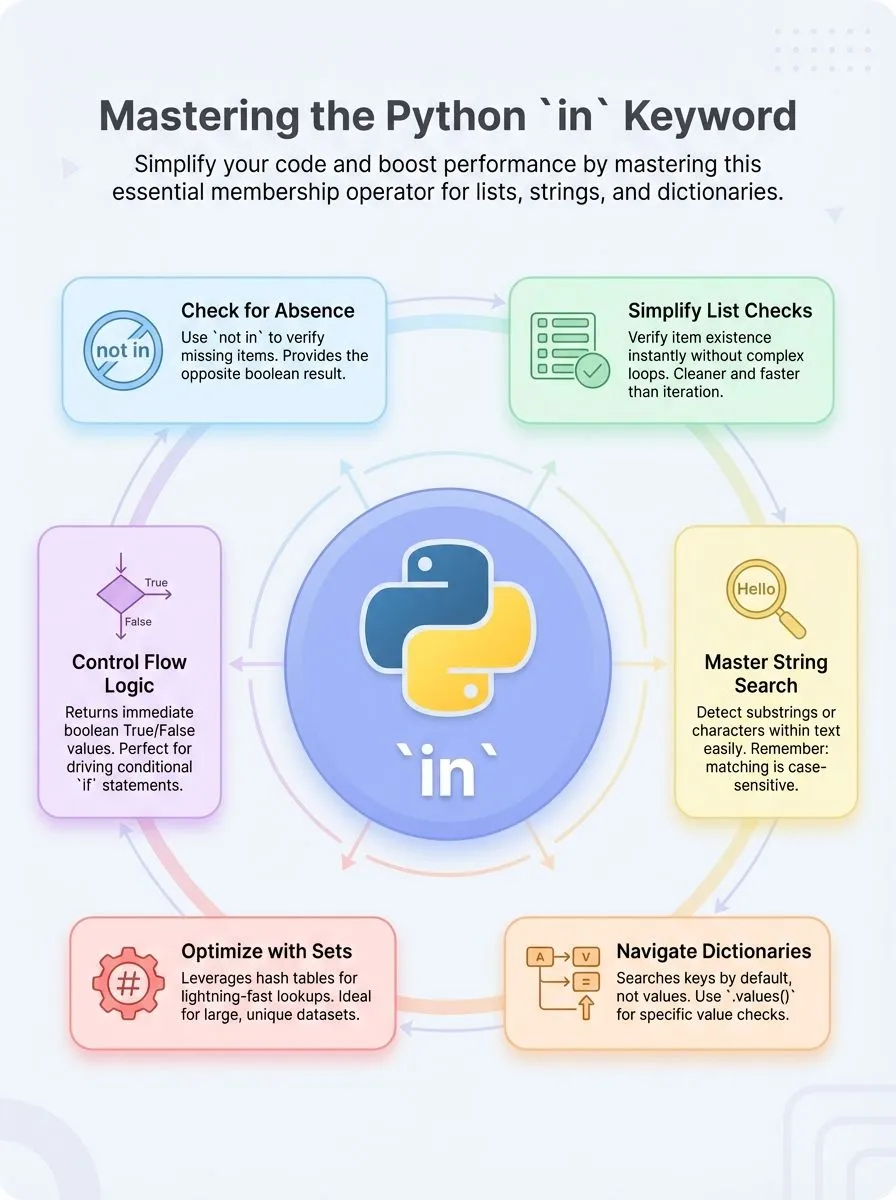
- Python’s in keyword serves as a built-in membership operator that checks if elements exist in lists, strings, dictionaries, and sets efficiently.
- The in operator returns True or False boolean values and works faster than manual loops for membership testing across data structures.
- Dictionary searches with in keyword check only keys, not values, while sets use hash tables for lightning-fast membership operations.
- String membership checks using in keyword can find single characters or complete substrings within larger text data structures effectively.
- The in keyword eliminates complex loop structures and optimizes performance differently based on data type for cleaner, readable code.
What is the Python in Keyword?

The in keyword stands as one of Python’s most powerful built-in operators for checking membership and controlling program flow. This reserved word serves dual purposes in programming: it tests whether an element exists within a sequence like lists, tuples, strings, sets, or dictionaries, and it drives iteration in for loops.
Joshua Correos from Web Design Booth frequently uses this operator when building secure web applications, noting how it simplifies code while maintaining excellent performance.
The in keyword transforms complex membership checks into simple, readable code that any programmer can understand at first glance.
This membership operator works with various data structures including arrays, hash tables, and iterable objects. The syntax remains consistent across different sequence types: `element in sequence` returns a boolean value of True or False.
The python compiler optimizes these operations differently based on the data type, using hash table lookup for dictionaries and sets, while employing linear search for lists and tuples.
This versatile keyword eliminates the need for complex loop structures when determining if specific values exist within collections.
How Does the in Keyword Work in Python?
Python’s in keyword acts as a membership operator that searches for elements inside data structures. This python built-in operator checks if a value exists within sequences like lists, strings, sets, or dictionaries.
The keyword work happens through a simple search algorithm that examines each element until it finds a match or reaches the end. For strings, the operator performs substring checks across the entire text.
Lists get scanned from start to finish, while sets use their internal structure for faster lookups. Dictionary searches focus only on keys, not values, making the search time quick and efficient.
The in operator returns a boolean value, either True or False, based on what it discovers. Conditional statements use this operator with simple syntax: `if element in sequence:` followed by the code to execute.
Control flow structures rely on this comparison operator to determine which path the program should take. Python uses binary logic to process these membership checks, making them perfect for filtering data or validating input.
The expression evaluates instantly, giving programmers a powerful tool for creating dynamic applications. This functionality works across all major data types, from simple arrays to complex associative arrays, making it essential for any python functions that need to verify content existence.
Examples of Using the in Keyword for Membership Checks
Python’s in keyword serves as a powerful membership operator that checks if specific elements exist within various data structures, making it an essential tool for efficient programming and data validation tasks.
How Can You Check if an Item Exists in a List Using in?
Alex Herrick often uses the in keyword for quick membership checks in Python lists. This operator makes code cleaner and faster than traditional loop methods.
- Create a list with items like
a = ["php", "python", "java"]and use the in keyword to test if “php” exists in the list, which returns True as output. - Place the in keyword inside an if statement to execute code only when an item is present in a list, making conditional logic simple.
- Use the in operator with any data type stored in lists, including strings, numbers, or complex objects for flexible membership testing.
- Check multiple items at once by combining the in keyword with logical operators like
andororfor complex conditions. - Apply the in keyword with variables containing the search item, such as
search_term in my_list, for dynamic membership checks. - Test for absence using
not into verify when items are missing from lists, providing the opposite result of the in operator. - Implement the in keyword with list methods and functions to create efficient filtering operations without writing complex loops.
- Speed up execution by using the in keyword instead of manual iteration, as Python optimizes this operator for better performance.
How Do You Use in with Strings for Substring Checks?
The in keyword transforms string processing into a simple task for Python developers. This membership operator checks if characters or substrings exist within larger strings, making code more readable and efficient.
- Check single characters in strings by typing character in string_name, which returns True if the character exists and False if it doesn’t.
- Search for complete substrings using the same syntax, allowing developers to find words or phrases within text data quickly and accurately.
- Create loops that iterate through string characters using for char in string_name, giving precise control over each character during processing tasks.
- Break loops early when specific characters appear by combining the in operator with conditional statements and break commands for targeted string analysis.
- Use the in operator with string slicing to check portions of text, enabling focused searches within specific string segments or ranges.
- Combine in checks with if statements to create powerful text filtering systems that process strings based on character or substring presence.
- Apply case-sensitive matching rules since the in operator distinguishes between uppercase and lowercase letters during string comparisons and searches.
- Process the string “GeeksforGeeks” character by character, printing G, e, e, k, s until reaching ‘f’, then stopping the loop execution completely.
- Build text validation systems using in operators to verify user input contains required characters or avoids forbidden substring patterns.
- Stack multiple in checks together using logical operators like and or or to create complex string validation rules for data processing.
- Convert string searches into boolean values for assignment to variables, enabling storage of search results for later program logic decisions.
Can in Be Used with Dictionaries and Sets?
Python’s in keyword works perfectly with dictionaries and sets for membership operators. This feature makes checking for data much faster than using loops or other methods.
- Dictionary membership checks look for keys, not values, making searches quick and simple for any size data structure.
- Sets use the in keyword to find specific items with lightning speed since they store unique values only.
- Dictionary example shows
d = {"Alice": 90, "Bob": 85}where checking if “Alice” exists as a key returns True instantly. - Set operations with in keyword run faster than list searches because sets use hash tables for storage.
- Checking dictionary values requires different syntax like
90 in d.values()instead of direct membership testing. - Sets eliminate duplicate entries automatically, so membership checks always return accurate results for unique items.
- Dictionary keys can be strings, numbers, or other immutable objects, and in keyword works with all types.
- Large datasets benefit most from dictionary and set membership checks compared to array searches.
- Set comprehension creates new collections where in keyword helps filter existing data efficiently.
- Both dictionaries and sets support the not in operator for checking missing items or keys.
Conclusion
The Python in keyword stands as one of the most powerful tools for checking membership in data structures. This operator makes code cleaner and faster when working with lists, strings, dictionaries, and sets.
Creative professionals and tech enthusiasts can use this knowledge to build better programs and solve real problems. Web Design Booth’s team uses these Python techniques daily to create efficient web applications that serve clients worldwide.
Master the in keyword, and watch your Python programming skills reach new heights.
For more in-depth information on how expressions work with the `in` keyword in Python, visit this comprehensive guide.
FAQs
1. What makes the keyword in python operator so powerful for checking membership?
The keyword in python works as a comparison operator that checks if an item exists in python strings, arrays, or lists. This operator provides a clean, readable way to search through data structures without writing complex loops or using naive search methods.
2. How does python handle different data types when using membership operators?
Python (programming language) supports membership checks across various data structures including strings, lists, pandas dataframes, and numpy arrays. The language automatically handles type comparison and index searching behind the scenes.
3. Can you use list comprehension with membership operators for advanced filtering?
List comprehension combined with the in operator lets you create a new list based on membership conditions. This approach beats traditional loops for speed and readability in most cases.
4. What role do python generators play in efficient keyword searching?
Python generators help save memory when checking large datasets for keyword matches. They process one item at a time instead of loading everything into memory, making searches more efficient for big data sets.
5. How do assignment and variable operations work with membership checking results?
Assignment (computer science) lets you store membership check results in variables for later use. You can assign true or false values from membership tests to variables, then use these in conditional statements or further processing.
6. What computer science concepts make python’s membership operators fast?
The language uses optimized algorithms similar to quicksort for ordered data and hash tables for key and value pairs. These methods avoid naive linear searches, making membership checks much faster than basic comparison approaches.