

Python developers often struggle with choosing between return and yield statements when building functions. The return keyword can only deliver one value at a time, while yield creates a generator function that can produce multiple results.
This guide breaks down python yield vs return differences with clear examples and practical tips to help you pick the right tool for each coding task. Master these concepts today.
Key Takeaways
- Return statements end function execution immediately and send a single value back to the caller.
- Yield creates generator functions that produce multiple values on demand while maintaining function state between calls.
- Generators using yield consume less memory by producing values one at a time instead of storing everything.
- Use yield for large datasets, infinite sequences, and file processing to prevent memory overload crashes.
- Return works best for simple calculations and single-value operations that don’t require memory optimization.
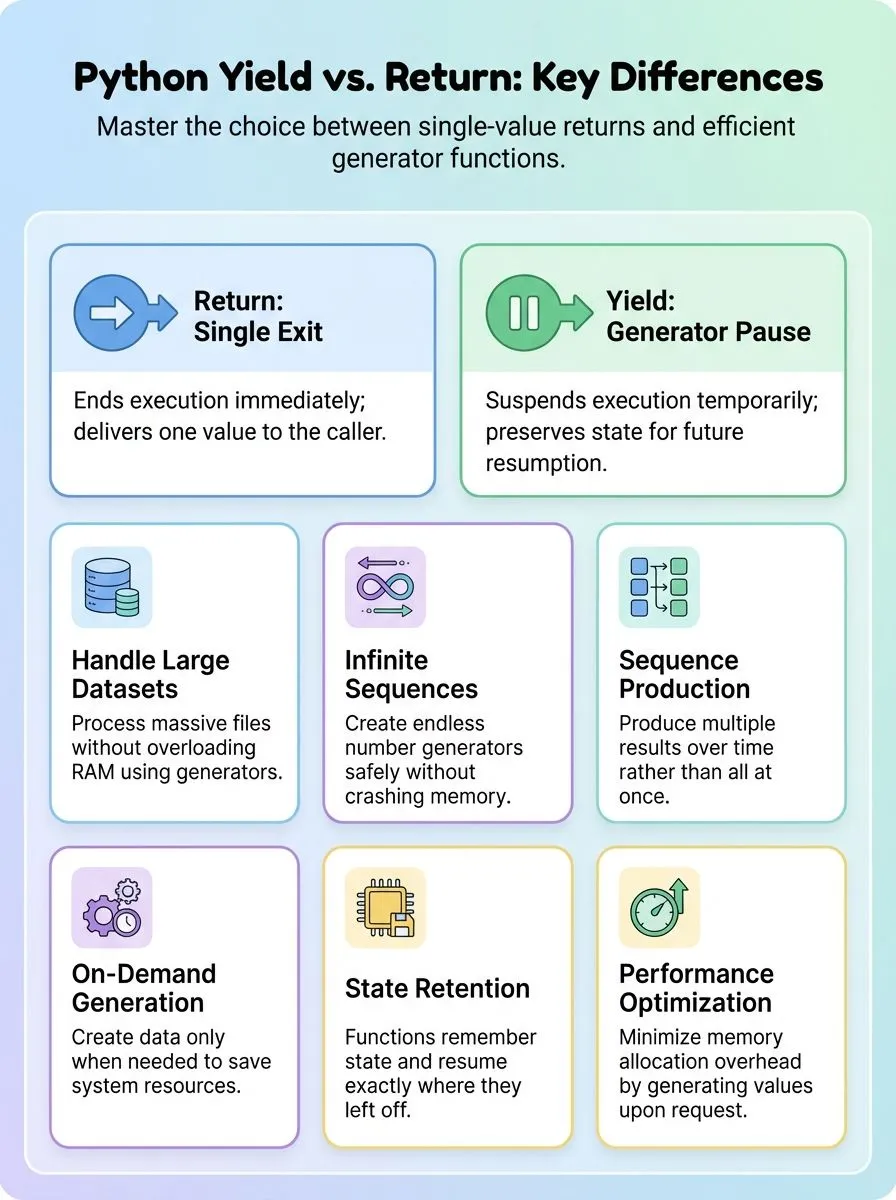
What does the return statement do in Python?

The return statement in Python acts as the final messenger in a function’s journey. This powerful keyword exits a function and delivers a value back to the caller who requested it.
Alex Herrick from Web Design Booth has observed countless developers struggle with this concept during his ten years of building custom WordPress themes. The return statement marks the end of a function’s execution, sending results directly to whoever called that function.
Code after a return statement never runs, making it a definitive stopping point.
The return statement is the bridge between what a function computes and what the caller receives.
Functions can have several return statements scattered throughout their code, but only one executes per function call. The return statement is used to exit a function and return a single value to the waiting caller.
If no expression follows the return keyword, Python automatically returns None. This statement can deliver any type of data back to the caller, including lists, dictionaries, or custom objects.
For example, a class Test function might return a Test object with specific attributes like `str` and `x`, giving the caller exactly what they need to continue their program’s flow.
What does the yield statement do in Python?
The yield keyword transforms any regular Python function into a generator function. This transformation happens automatically when Python sees the yield statement in the code. Unlike normal functions that return a single value and end their execution, generator functions create a special generator object.
This object can produce a sequence of values over time instead of returning all results at once. The yield statement suspends function execution, delivers a value back to the caller, and keeps the function’s state intact for later use.
Generator functions work differently from normal functions in memory management and control flow. Each time the generator produces a value, execution pauses at the yield point and waits for the next request.
The function resumes from where it left off when called again, maintaining all local variable states. For example, the simple function `def simpleGeneratorFun(): yield 1; yield 2; yield 3` creates a generator that produces three values upon iteration.
This approach prevents storing the entire sequence in memory at once, making generators perfect for handling large datasets or infinite sequences. The yield keyword allows code to produce a series of values efficiently while controlling memory allocation overhead.
Key differences between yield and return
Understanding these core differences between yield and return will transform how developers approach function design and memory management in their Python projects.
How does yield differ from return in function behavior?
The return statement ends function execution immediately and sends a value back to the caller. Functions using the return statement deliver a value back and stop running completely.
Yield works differently by suspending function execution temporarily instead of ending it. Functions with yield statements create generator objects that can resume from where they left off during the last yield run.
Generator functions produce values one at a time through the yield keyword rather than returning all results at once. Each time code calls a generator function, execution can be temporarily halted at the yield statement.
The function remembers its state and continues from that exact spot on the next call. Return statements cannot restart function execution once they finish, while yield produces a sequence of values that programmers can iterate over multiple times.
When should I use yield instead of return?
Choosing between yield and return depends on your specific programming needs. Smart developers pick yield when they want to create generator functions that produce values one at a time.
- Large datasets require yield to avoid memory overload. Python generators help process massive files without storing everything in RAM at once.
- Infinite sequences work best with yield statements. Create endless number generators like
def nextSquare(): i = 1; while True: yield i * i; i += 1for safe iteration. - File processing benefits from yield’s memory efficiency. Read huge text files line by line without crashing your computer’s memory.
- Multiple values need yield instead of return statements. Generator functions can produce several results over time, unlike return which stops execution immediately.
- On-demand value generation suits yield perfectly. Produce data only when needed rather than creating everything upfront and wasting resources.
- Iterating over sequences works better with yield. Loop through data collections without storing all values in memory simultaneously.
- Performance optimization calls for yield in data processing. Reduce memory allocation overhead by generating values as the program requests them.
- Resume functionality requires yield over return statements. Generator functions pause execution and resume from where they left off, maintaining state between calls.
What are the performance implications of yield vs return?
**Memory Usage Makes the Biggest Difference**
Generator objects created with yield allow value retrieval on demand, without allocating space for all results at once. This approach minimizes memory usage significantly compared to return statements.
Return can cause higher memory usage if returning large lists or data structures, as the entire result gets stored at once. Yield retains local variable state in the generator function, which controls memory allocation overhead during data-intensive operations.
Generators using yield avoid the need to create and store intermediate data structures like lists or dictionaries. Using yield proves advantageous when dealing with large or streaming datasets, as only one value stays in memory at a time.
The performance boost becomes clear with massive data sets, where return would crash programs due to memory limits. Understanding these memory patterns helps developers choose the right approach for their specific use cases.
Conclusion
Python developers face this choice every day: yield or return? Both statements serve different purposes in code. Return statements send single values back to callers and end function execution immediately.
Yield statements create generator objects that produce multiple values on demand while saving memory.
Smart programmers choose yield when working with large datasets or infinite sequences. This approach prevents memory overload and keeps applications running smoothly. Return works best for simple calculations and single-value operations.
Understanding these differences helps developers write better Python code. The right choice depends on specific project needs and performance requirements. Mastering both concepts opens doors to more efficient programming solutions.
For more in-depth information on Python keywords, check out this comprehensive guide at Understanding Python Keywords.
FAQs
1. What is the main difference between return and yield in Python?
The return statement passes a value back to the caller and ends the function completely. Yield is used to create generator functions that can pause and resume from where they left off, returning values one at a time.
2. Can a function in Python have several return statements?
Yes, a function can have several return statements in different parts of its code. However, only one return statement will execute during each function call, and it will end the function immediately.
3. What happens when you use the yield function instead of return in Python?
The yield statement creates a generator object that can iterate over a sequence of values. Unlike return, yield pauses the function and saves its state, allowing it to resume later and generate multiple values over time.
4. How do generator functions and normal functions differ in their behavior?
Normal functions use return statements in their definitions and complete their execution when they return a value. Generator functions use yield statements and return another generator object that produces values on demand without finishing the entire computation at once.
5. What type of object does yield return compared to a regular return statement?
A regular return statement returns the value directly to the caller as specified. Yield returns a generator object that must be iterated over to access the generated values, making it memory efficient for large datasets.
6. Why would you choose yield over return when processing large amounts of data?
Yield allows you to process data piece by piece without loading everything into memory at once. This approach is perfect for handling big files or endless sequences where a traditional return statement would consume too much memory or crash your program.